
Let's cut to the chase. What exactly is a security token?
Think of it as a digital stock certificate or property deed that lives on a blockchain. Instead of a piece of paper locked in a safe, a security token is a digital representation of ownership in a real-world asset. This means your ownership is cryptographically secure and can be traded anywhere in the world, 24/7.
The Bridge Between Old Money and New Tech
A security token isn't just another crypto coin; it's a regulated, digital investment contract. Its value is tied directly to something external and tradable—a share in a startup, a piece of a rental property, or even a stake in a multi-million dollar painting.
Because these tokens represent actual ownership and you expect to profit from them, they fall under securities laws. This gives investors the same kind of legal protections they get with traditional stocks and bonds.
This is the critical difference between a security token and something like a utility token. A utility token might give you access to a service (like a digital key), but a security token gives you an ownership stake with real financial rights. It’s this structure that’s getting both Wall Street and crypto-native investors to pay attention.
What Makes a Security Token a Security Token?
So, what are the core ingredients? A security token really boils down to a few key traits that make it a regulated financial instrument.
To give you a quick overview, here’s a summary of its core attributes.
| Attribute | Description |
|---|---|
| Asset-Backed | Its value is derived from a real-world, tradable asset. |
| Regulated | It must comply with securities laws, offering investor protections. |
| Programmable | Smart contracts automate dividends, voting, and compliance. |
| Fractional Ownership | Divides high-value assets into smaller, affordable shares. |
This combination creates a powerful new way to invest, making markets more efficient and open to everyone.
For instance, you could own a tiny slice of a commercial building in New York and receive your share of the rental income automatically through a smart contract. That’s a massive upgrade from the old way of doing things.
The key takeaway here: security tokens aren’t about inventing new speculative assets. They’re about upgrading the plumbing for existing, proven ones by merging the legal frameworks of traditional finance with the speed and global reach of the blockchain.
This isn’t just a niche idea, either. The market for digital securities is growing fast. Valued at USD 1.91 billion in 2023, the global security token market is projected to hit USD 17.44 billion by 2030, growing at a compound annual rate of 27.3%. This explosive growth shows that investor confidence is rising as the rules of the road become clearer.
Venture capital firms were some of the first to jump in, with pioneers like Blockchain Capital leading the charge years ago.
Understanding the Legal Framework of Security Tokens
So, what really separates a security token from every other crypto asset out there? It’s not the tech. It’s the law.
That legal backbone is what gives a security token its teeth, turning it from a speculative coin into a regulated investment. Without it, you’ve just got code. With it, you have a verifiable stake in a real-world business.
The main tool regulators use to draw this line, especially in the US, is the Howey Test. It comes from a 1946 Supreme Court case, and its whole job is to figure out if a transaction is an "investment contract" and needs to play by securities rules.
The Howey Test Simplified
The Howey Test isn't as scary as it sounds. It just boils down to four simple questions:
- Is there an Investment of Money? Did someone put capital into the venture?
- Is it a Common Enterprise? Are all the investors' fortunes tied to the same project?
- Is there an Expectation of Profit? Is the main reason for investing to make money?
- Does it rely on the Efforts of Others? Are you expecting a third party, like the management team, to do the work that generates those profits?
If the answer to all four is "yes," then the U.S. Securities and Exchange Commission (SEC) sees that digital asset as a security. This is a huge deal for investor protection. It means the issuer has to be transparent, disclose financials, and be legally on the hook for their promises.
The Howey Test acts as a critical filter. It separates assets that are merely for use (like utility tokens) from those that are fundamentally investments (security tokens), ensuring that investors receive the protections they are entitled to under securities law.
This legal clarity is exactly why serious investors and institutions are finally warming up to tokenization. As the rulebook for digital assets gets written, it helps to look at existing models for managing securities and compliance for real estate syndication, since those traditional frameworks offer a battle-tested blueprint.
Security Token Offerings vs. ICOs
Remember the ICO craze? The fundraising method for security tokens, called a Security Token Offering (STO), is the complete opposite. Where ICOs felt like the Wild West of fundraising, operating in a regulatory fog, STOs are built on a foundation of legal compliance from day one.
An STO is a fully regulated process. Unlike ICOs that were open to pretty much anyone with a crypto wallet, STOs come with strict rules for issuers, like:
- Investor Verification: Running proper Know Your Customer (KYC) and Anti-Money Laundering (AML) checks.
- Accreditation Status: Often limiting sales to accredited investors who meet specific income or net worth requirements.
- Full Disclosure: Providing a firehose of documentation about the asset, the business plan, and all the risks involved.
This commitment to playing by the rules has built a much more trustworthy environment, pulling in the institutional money that ran for the hills during the ICO boom. The numbers don't lie. The security token offering market, valued at USD 1.87 billion in 2022, jumped to USD 2.14 billion in 2023. It's projected to hit USD 7.14 billion by 2030, growing at a compound annual rate of 14.33%. That steady climb shows real institutional adoption is here. You can dig deeper into this STO market growth on globalgrowthinsights.com.
The legal framework isn't a hurdle; it's the bedrock. By embracing regulation, security tokens are building a compliant bridge between traditional finance and the blockchain. As these new assets join your portfolio, you can track everything—crypto, stocks, and tokenized securities—in one place with a tool like the CoinStats Portfolio tracker. And when you need to make sense of it all, CoinStats AI can give you the data-driven insights to inform your next move.
Security Tokens vs. Utility Tokens vs. Cryptocurrencies
In crypto, the word "token" gets tossed around a lot. But not all tokens are created equal. Far from it.
To really get what a security token is, you need to see how it stacks up against its more famous cousins: utility tokens and cryptocurrencies. Each plays a completely different game, and mixing them up can be a seriously expensive mistake for any investor.
Think of it like this: a cryptocurrency like Bitcoin is basically digital money. Its whole point is to be a decentralized way to pay for things or store value, free from any central bank or government.
A utility token is more like an arcade token or a keycard. It grants you access to a specific product or service on a network. It's a key, not a piece of the company.
Then there are security tokens. These are a whole different beast. A security token is a digital contract that represents actual ownership in a real-world asset.
It's All About Purpose and Value
The real difference comes down to intent. Cryptocurrencies want to be money. Utility tokens want to grant access. But security tokens? They are designed from day one to be financial investments.
The whole point of a security token is to be the digital version of a stock, bond, or slice of real estate. Its value is directly tied to the performance, revenue, or valuation of an underlying asset, and holders are there to make a profit.
This isn't just a technical detail—it has massive legal and financial consequences. Because they're investments, security tokens are subject to strict securities laws designed to protect investors from getting rekt.
Utility tokens and most cryptocurrencies, on the other hand, often live in a regulatory gray area, which comes with its own set of risks. Knowing the difference is a must before you put any capital on the line.
A Side-by-Side Comparison
To make the lines between them crystal clear, let’s break down how these three digital asset categories really compare. Each one has a unique profile when it comes to its job, its legal status, and where its value comes from.
Here’s a direct comparison outlining the fundamental differences.
Comparing the Major Digital Asset Categories
| Feature | Security Token | Utility Token | Cryptocurrency (e.g., Bitcoin) |
|---|---|---|---|
| Primary Purpose | Represents ownership in an asset; an investment contract. | Provides access to a product, service, or network. | Acts as a decentralized medium of exchange or store of value. |
| Underlying Value | Tied to the value of a real-world asset (e.g., equity, real estate). | Based on the demand for the network's service or product. | Driven by market supply and demand, network adoption, and security. |
| Legal Status | Regulated as a security (e.g., by the SEC). | Generally unregulated as a security, but this can be a grey area. | Varies by country; often treated as property or currency. |
| Investor Expectation | Expects profits from dividends, appreciation, or revenue share. | Expects to use the token for its intended function within an ecosystem. | Expects price appreciation or use as a payment method. |
| Issuance Method | Security Token Offering (STO), which is a regulated process. | Initial Coin Offering (ICO) or airdrop, often with fewer rules. | Mining, staking, or initial distribution event. |
As you can see, the lines are pretty sharp. Buy a security token, and you're buying a piece of a business. Buy a utility token, and you're buying a key to a platform.
With a growing portfolio that might hold all three types, using a tool like the CoinStats Portfolio tracker is essential to keep a clear eye on all your holdings. And for deeper insights across these different asset classes, you can turn to tools like CoinStats AI to get data-driven intelligence.
How Real-World Assets Become Security Tokens
Ever wonder how a solid, tangible asset like a skyscraper or a high-performing venture fund gets broken down into digital tokens you can trade from your phone? The process is called tokenization, and it’s how the physical world meets the blockchain. It's all about taking an asset's ownership rights and baking them into a smart contract.
Let's walk through a real-world example to see how this actually works: tokenizing a commercial office building.
This isn't just some tech magic. It's a structured financial and legal playbook that turns a clunky, high-value asset into divisible, liquid digital shares. The end goal? Making an investment in prime real estate feel as easy as buying a stock.
The Tokenization Blueprint Step-by-Step
The journey from a physical building to a wallet full of security tokens follows a clear roadmap. Every step is crucial to ensure the final token is legally compliant, secure, and actually represents the asset's value.
Here's the breakdown:
-
Asset Selection and Valuation: First, the building's owner decides to tokenize it. They bring in a professional appraiser to get a fair market value—let's say $50 million. This number is the foundation for the entire offering.
-
Legal Structuring: Next, lawyers get involved. The building is placed into a Special Purpose Vehicle (SPV), which is just a fancy legal shell (like an LLC) created for one purpose: to hold the asset. This firewalls the building from the original owner's other debts and creates a clean, transferable ownership structure.
-
Regulatory Compliance: This is where the real heavy lifting happens. The legal team structures the offering to meet securities regulations. A lot of security tokens are launched using established financial frameworks like investing in private placements, which often limit the initial sale to accredited investors to stay on the right side of the law.
From Legal Docs to Smart Contracts
Once the legal framework is solid, the tech team takes over. They translate all that paper-based ownership into programmable rules on the blockchain.
The heart of this step is the smart contract. Think of it less as code and more as a self-executing agreement where the investment terms are written directly into the blockchain. It's an automated, transparent rulebook.
A smart contract for tokenized property might have a rule like this: "On the first of every month, automatically distribute 90% of all rental income as dividends to token holders, proportional to their stake."
This automation is what makes security tokens so powerful. It cuts out middlemen, slashes administrative costs, and makes sure investors get paid on time, every time. Following our example, the issuer might create 50 million tokens, pegging each one to a $1.00 share of the property's equity.
This is where security tokens really stand apart from other digital assets. They aren't just for payments or granting access to a platform; they represent a legal claim on a real-world asset.
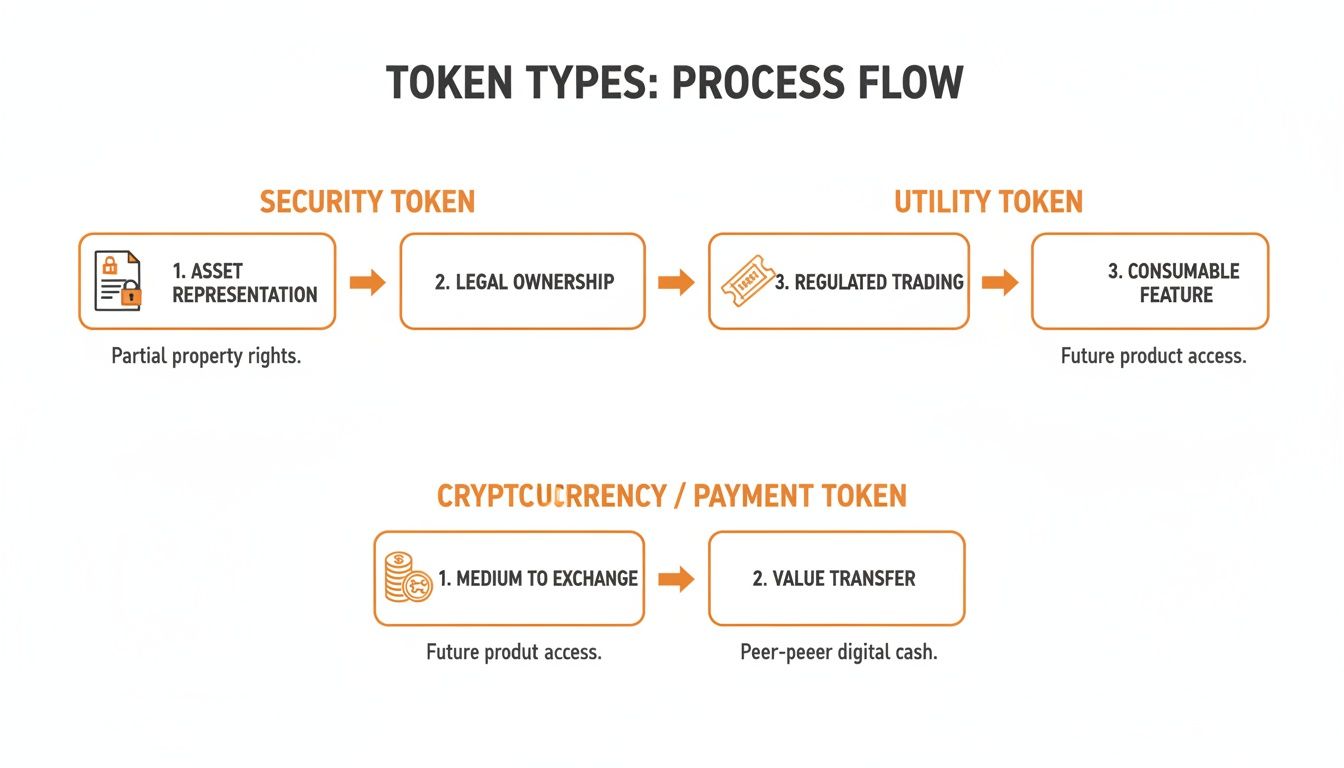
As the chart shows, while crypto acts as money and utility tokens act as keys, security tokens are unique because they are backed by legally recognized ownership.
Launching the Security Token Offering
With the tokens minted and the smart contract live on a blockchain (like Ethereum or Polygon), it’s time for the Security Token Offering (STO). This is the official, regulated sale where investors can get in on the action.
During the STO, investors go through strict Know Your Customer (KYC) and Anti-Money Laundering (AML) checks to verify who they are. Once approved, they can buy the tokens, and their ownership is permanently recorded on the blockchain for everyone to see. This creates a direct, transparent link between an investor and a valuable, income-producing asset.
You can see this in action with real-world products like the Securitize tokenized AAA CLO fund, which brings complex financial instruments on-chain for investors.
Of course, once you own these new assets, you need to track them. The CoinStats Portfolio tracker is built for exactly this, letting you monitor everything—from your Bitcoin to your slice of tokenized real estate—in one dashboard. For deeper analysis, CoinStats AI can give you data-driven insights across your entire portfolio to help you make smarter moves.
The Big Payoff: Benefits of Security Tokens
Okay, so we’ve covered the "what" and the "how." But let's get to the real question: why should you even care about turning real-world assets into security tokens?
It all boils down to breaking down old walls. Tokenization is prying open investment worlds that were previously sealed shut, and everyone from regular investors to huge institutions is taking notice.

The single biggest shift is how it makes high-value assets available to everyone. Before this, if you wanted a piece of a Manhattan office building, a priceless painting, or a private venture capital fund, you needed to be ultra-wealthy. Security tokens completely change the game with fractional ownership.
Making Exclusive Assets Accessible
Fractional ownership is exactly what it sounds like. You digitally slice up a big, expensive asset into thousands or even millions of smaller, affordable pieces. You no longer need $5 million to get a slice of a commercial property; you can buy a token representing a $500 stake.
This blows the doors open on markets that were traditionally illiquid and exclusive. It gives a much broader range of people a shot at building wealth from asset classes once completely dominated by the big fish.
Here’s where it gets really interesting:
- Real Liquidity: Assets like real estate or private equity can lock up your cash for years. Tokenizing them means the shares can trade on global, 24/7 secondary markets. This creates more chances to buy and sell, which is a massive upgrade.
- Hands-Off Compliance and Payouts: This is where smart contracts really shine. They can automatically check if an investor is verified before allowing a trade. Even better, they handle dividend and interest payouts, sending profits straight to token holders' wallets without middlemen or delays.
- Crystal-Clear Ownership: Every single transaction is recorded forever on the blockchain. This creates a perfect, auditable paper trail of who owns what, cutting down on fraud and ownership fights.
By building the rules directly into the token itself, you slash administrative costs and make complex financial legwork way more efficient. This automation is a huge reason why institutions are so excited about what a security token can do.
And the numbers back it up. The asset tokenization market, with security tokens at its heart, was valued at USD 2,024.55 billion in 2023. It’s projected to hit a massive USD 7,795.83 billion by 2030, growing at a blistering 40.1% compound annual growth rate. That kind of growth shows just how much confidence institutions are putting into regulated digital assets. You can dig deeper into these market trends on thebusinessresearchcompany.com.
Real-World Examples in Action
The theory is cool, but seeing it in the wild is what really makes it click. We're already seeing security tokens used in clever ways to change how companies raise money and how people invest.
Example 1: The Tokenized VC Fund
A venture capital fund tokenizes its entire portfolio of startup investments. Instead of needing millions to become a limited partner, you can buy tokens that represent a tiny piece of the whole fund. You get exposure to a bunch of early-stage companies, and if one of them has a big exit, the profits are paid out automatically to all the token holders.
Example 2: Revenue-Sharing for a Movie
An indie filmmaker needs to fund their next project. They skip the traditional Hollywood route and instead issue security tokens. These tokens give holders a right to a percentage of the film's future box office earnings. Investors get to be stakeholders in the movie's success, and the smart contract makes sure they get their cut without any funny business.
These aren't just ideas on a whiteboard; they're happening now. As you start to explore these new kinds of investments, keeping track of everything—from your Bitcoin to your tokenized real estate—gets complicated. Using a dedicated tool like the CoinStats Portfolio tracker is a lifesaver, letting you see all your holdings in one place. And if you want to dig deeper, you can ask CoinStats AI to analyze market data and give you insights on your entire collection of assets.
How to Invest in Security Tokens
So, you're ready to move beyond the usual crypto and traditional stocks. Stepping into the world of security tokens is a solid next move, but it’s a different ballgame. Unlike the Wild West of some unregulated crypto markets, you’ll be dealing with platforms that operate under strict financial rules, which means a more structured, buttoned-up experience.
First things first, you can't just buy these on any old crypto exchange. You need to find a regulated marketplace that specializes in digital securities. These platforms are built from the ground up to make sure every single offering is compliant with securities laws, giving you a safety net you won’t always find in the broader crypto space.
Finding and Buying Your First Security Token
The main places to get your hands on security tokens are specialized exchanges and issuance platforms. Again, these aren't your typical crypto exchanges; they’re designed to navigate the legal maze that comes with trading regulated financial instruments.
A couple of the big players you’ll run into are:
- Securitize Markets: A leader in this space, they offer a pretty wide menu of tokenized assets, everything from real estate funds to venture capital. They handle all the investor verification to keep things compliant.
- tZERO: Backed by some heavy institutional hitters, tZERO is focused on creating a liquid secondary market where you can trade a variety of digital securities.
Getting started usually means creating an account, going through the standard Know Your Customer (KYC) and Anti-Money Laundering (AML) checks, and often, proving you’re an accredited investor. Once you’re approved, you can browse what's on offer and invest directly. Your new tokens are then sent to a compatible digital wallet. You can even find some interesting assets popping up on-chain, like the Fidelity Digital Interest Token.
Managing a Modern, Diversified Portfolio
Okay, so your portfolio is getting complicated. You've got stocks, a mix of crypto, and now tokenized assets. Bouncing between your brokerage app, a few crypto exchanges, and a security token platform is a headache. It makes it almost impossible to get a clear picture of your entire financial situation.
This is where having one place to see everything becomes a lifesaver. The goal is to get a single, clean view of all your holdings, no matter where they live, so you can actually make smart decisions.
This is exactly what a tool like the CoinStats Portfolio tracker was built for. You can connect all those different exchange accounts and wallets to see every asset you own—from your Bitcoin and Ethereum to your newly acquired security tokens—all in one dashboard. It gives you a true look at your entire net worth in one place.
But you can do more than just track. With advanced tools like CoinStats AI, you can get data-driven insights across the whole digital asset ecosystem. This helps you spot trends, manage your risk, and make smarter moves, whether you’re rebalancing your crypto or thinking about your next security token investment.
Common Questions About Security Tokens
Got questions? Of course you do. The world of tokenized assets can feel a little confusing at first. Let's cut through the noise and tackle some of the most common things people wonder about.
Are Security Tokens Just Another Name for NFTs?
Not even close. While both run on blockchain, their purpose is completely different.
A security token is fungible. That means each one is identical and interchangeable, just like a share of Apple stock. One share is the same as any other. They represent a real financial stake in an asset and are treated as securities by regulators.
NFTs are non-fungible—each one is unique and can’t be swapped for another. They're all about proving you own one specific thing, like a piece of digital art or a rare collectible. Their legal standing, value, and the markets they trade on are in a totally different universe.
What Are the Biggest Risks of Investing in Security Tokens?
While tokenizing assets has some serious perks, it's not a risk-free game. Anyone looking to jump in should be aware of a few key hurdles in this still-growing market.
Here’s what to watch out for:
- Liquidity Risk: The whole point of tokenization is to make assets easier to trade, but we're still in the early innings. Finding a buyer for a niche security token can be a lot harder than selling shares on the NYSE.
- Regulatory Risk: The rulebook for digital assets is still being written. A sudden change in government policy could throw a wrench in the works, affecting the value and legality of your tokens.
- Smart Contract Risk: The token’s DNA—its rules, its functions—is all coded into a smart contract. A single bug or undiscovered vulnerability could be exploited, and poof, your investment could be at risk.
- Platform Risk: You’re not just betting on the token; you're also betting on the platform where you buy and store it. If that marketplace goes down or has security issues, your assets could be in limbo.
Can Anyone Just Go Out and Buy a Security Token?
Not always, and this is a huge deal. Since security tokens are regulated financial products, many of the initial offerings (STOs) are open only to accredited investors.
An accredited investor is someone who meets certain income or net worth requirements set by regulators like the U.S. Securities and Exchange Commission (SEC). The idea is to make sure that people participating in higher-risk private deals have the financial cushion to handle potential losses.
This is a night-and-day difference from most cryptocurrencies, which anyone can usually buy. As the market matures, we'll likely see more security tokens become available to everyday retail investors, but for now, many are invite-only.
How Do I Get Paid Dividends from These Things?
This is where the magic really happens. Dividends and profit-sharing are handled automatically by the smart contract. No waiting for a check in the mail.
When the underlying asset kicks off cash—like rent from a tokenized building or profits from a company—the smart contract is programmed to distribute that income directly to token holders. The payouts, often in a stablecoin, land right in your digital wallet. It’s transparent, efficient, and cuts out the slow, manual middlemen of the traditional finance world.
As you diversify into security tokens alongside your crypto holdings, keeping track of everything in one place is key. CoinStats offers a powerful solution with its all-in-one CoinStats Portfolio tracker. Connect your wallets and exchanges for a complete view of your assets, and leverage CoinStats AI to gain data-driven insights across your entire portfolio.





0 Comments